Azerbaijan Tutor Training – March 2015.
Our newly trained Azerbaijan LEAP Tutors

Our Training Venue

Inside Our Training Venue

Baku The Old And The New


Azerbaijan Tutor Training – March 2015.
Our newly trained Azerbaijan LEAP Tutors
Our Training Venue
Inside Our Training Venue
Baku The Old And The New
Mozambique Tutor Training – November 2014.
A few pictures of the newly trained LEAP Tutors.


Learning is a choice. To choose to learn should be easy.
What can coaches do to help our learners make the choice to learn?
‘The Gap’
There are many reasons why our learners choose not to learn which can be summarised as ‘The Gap’.
So, you are out walking in the countryside when you reach a stream. The only way to get across this stream is to leap.
Leap across ‘The Gap’.
Whether our learners choose to leap or not will depend on a few things:
• “Why should I leap? Is there a good enough reason to leap?”
• “If I leap can I make it?”
• “If I don’t make it what are the consequences?”
• “Do I know how to leap?”
When coaching and helping our learners to choose to learn we can engineer ‘The Gap’. We can make the decision to leap easy. We can help our learners choose to learn by:
• Creating a good enough reason to leap.
• Making ‘The Gap’ just narrow enough.
• Making ‘The Gap’ just shallow enough.
• Making getting your feet wet normal and fun – a normal part of leaping.
• Making getting your feet wet safe.
• Helping them to enjoy leaping and getting wet.
• Helping them learn how to leap.
What if our learner still doesn’t want to leap?
So we have engineered ‘The perfect Gap’ and still our learner doesn’t want to leap. Perhaps our learner can see a better way to get across ‘The Gap’. Perhaps they don’t feel they need to leap. Perhaps they see that for them the best way of getting across ‘The Gap’ is to build a bridge.
To help our leaners learn their way; to build their bridge, they need enough time. Enough time to gather their resources. Enough time to piece their resources together. Enough time to test their bridge. Enough time to modify their bridge.
Help our learners learn by helping them to leap and giving them enough time to build a bridge.
I was recently observing a swimming lesson for 5 year old’s. Well, actually I was enjoying a coffee without paying much attention, until I heard the swimming coach say rather sternly to one of the children, “Calm down”. This got me thinking, do we really want our learners to ‘calm down’ or do we want them to be excited about learning and use that excitement to sustain their motivation to learn?
Two Types of Excited.
As I coach I see two types of excited behaviour. I see ‘Excited – On Task’ and ‘Excited – Off Task’.
‘Excited – On Task’, might be:
• Excited – engaged.
• Excited-interested.
• Excited – curious.
• Excited-improving.
• Excited-“I’m working it out!”
• Excited “I wonder if I can do the next level-up?”
‘Excited – Off Task’, might be:
• Excited-bored.
• Excited-confused.
• Excited-overwhelmed.
• Excited self-conscious.
• Excited-“I’m not as good as everyone else!”
• Excited – “I wish we were doing running, I’m good at that!”
We coaches should be aiming for excited learners, ‘Excited – On Task’ learners.
Copy Video Games.
If you have ever watched anyone playing a video game you will see a lot of, ‘Excited – On Task’. Video games create, ‘Excited – On Task’ by having levels that start easy and gradually get more difficult.
The motivation behind the progressive levels goes something like this:
• “I’m on level 3”. Current ability – Success.
• “I used to be on level 2”. Evidence of improvement – Success.
• “I’m nearly at level 4”. Belief – Future Success.
Video Games challenge the player to ‘work-out’ each level through experience and practice. This might be:
• “I am learning what I need to do to progress to the next level; I am working this out”. Learning – Success.
Video Games also have points which help to provide incremental evidence of moving towards ‘success’. Even if our gamers don’t complete a level, they may score more points – “I’m getting closer to completing this level”.
Adding points scoring to our practice sessions benefits our learners by:
• Quickly turning practice into a game like activity; helping to promote ‘Excited-On Task’. ‘Excited – Fun’.
• Helping our learners fail and fail again better.
So if we design practice sessions that look like video games, with levels and points, we create opportunities for success. We increase our chances of coaching ‘Excited-On Task’ learners. We minimise having to say, “Calm down”.
Please leave any questions you may have in the comments.
Effective coaches are always asking themselves “What can I do to help the athletes I coach progress more quickly? One solution to this is to design sessions that increase the amount Deliberate Practice.
Deliberate Practice is the type of practice you observe when your athletes are completely absorbed in what they are doing. Deliberate Practice is the type of practice where great increases in the speed of learning happen. Deliberate Practice is practice with the ‘concentration face’ on.
Concentration Face
To help the athletes we coach to put on their ‘concentration face’. We can do less:
• Less “This is happening”: More “What is happening?”
• Less “Try this…”: More “What could you do?”
• Less “Do this”: More “You could do, X, Y or Z, which will be best for you?”
• Less grouping on ability: More learning from each other in mixed ability groups.
• Less over challenge: More optimal challenge.
• Less “Well done”: More “Well done because…”
• Less session goals set: More purpose.
• Less structure: More creativity.
• Less about ability: More about improvement.
• Less intervention: More letting learning happen.
Less Thinking: More Doing.
When I was younger I played football. I remember a particular match where during the first half, I had played well, maybe the best I had ever played. I had been in the ‘zone’ – absorbed; my ‘concentration face’ had been on.
At half-time, our coach went around the team, with various points of advice for each player. His advice to me, “Whatever you are doing – keep doing it?” My second half was not as good.
Please leave a comment. What could my football coach have done less of? What could you do less of to help your learners learn more?
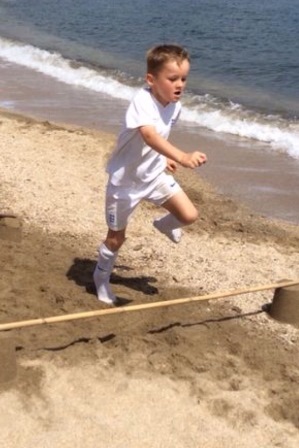 Ryan McLoughlin Athlete Of The Month Interview. Listen to Ryan talk about being energetic, fast and funny; being a leopard and Horrid Henry. (Approx. 5 minutes).
Some of you may know that I spent a week in Uganda, back in May, working with British Athletics, as part of their Tutor Training Team for the LEAP 2017 project.
Click here for overview of LEAP 2017 project.
Just a few pictures below to give you an idea of the trip:


Well done to everyone who represented SJAC at the recent Quadkids competition. Click here for all the results.
Events will be added soon
